

Difference in Differences with pymc models#
Note
This example is in-progress! Further elaboration and explanation will follow soon.
import arviz as az

import causalpy as cp
%load_ext autoreload
%autoreload 2
%config InlineBackend.figure_format = 'retina'
seed = 42
Load data#
df = cp.load_data("did")
df.head()
| group | t | unit | post_treatment | y | |
|---|---|---|---|---|---|
| 0 | 0 | 0.0 | 0 | False | 0.897122 |
| 1 | 0 | 1.0 | 0 | True | 1.961214 |
| 2 | 1 | 0.0 | 1 | False | 1.233525 |
| 3 | 1 | 1.0 | 1 | True | 2.752794 |
| 4 | 0 | 0.0 | 2 | False | 1.149207 |
Run the analysis#
Note
The random_seed keyword argument for the PyMC sampler is not necessary. We use it here so that the results are reproducible.
result = cp.DifferenceInDifferences(
    df,
    formula="y ~ 1 + group*post_treatment",
    time_variable_name="t",
    group_variable_name="group",
    model=cp.pymc_models.LinearRegression(sample_kwargs={"random_seed": seed}),
)
Initializing NUTS using jitter+adapt_diag...
Multiprocess sampling (4 chains in 4 jobs)
NUTS: [beta, y_hat_sigma]
Sampling 4 chains for 1_000 tune and 1_000 draw iterations (4_000 + 4_000 draws total) took 1 seconds.
Sampling: [beta, y_hat, y_hat_sigma]
Sampling: [y_hat]
Sampling: [y_hat]
Sampling: [y_hat]
Sampling: [y_hat]
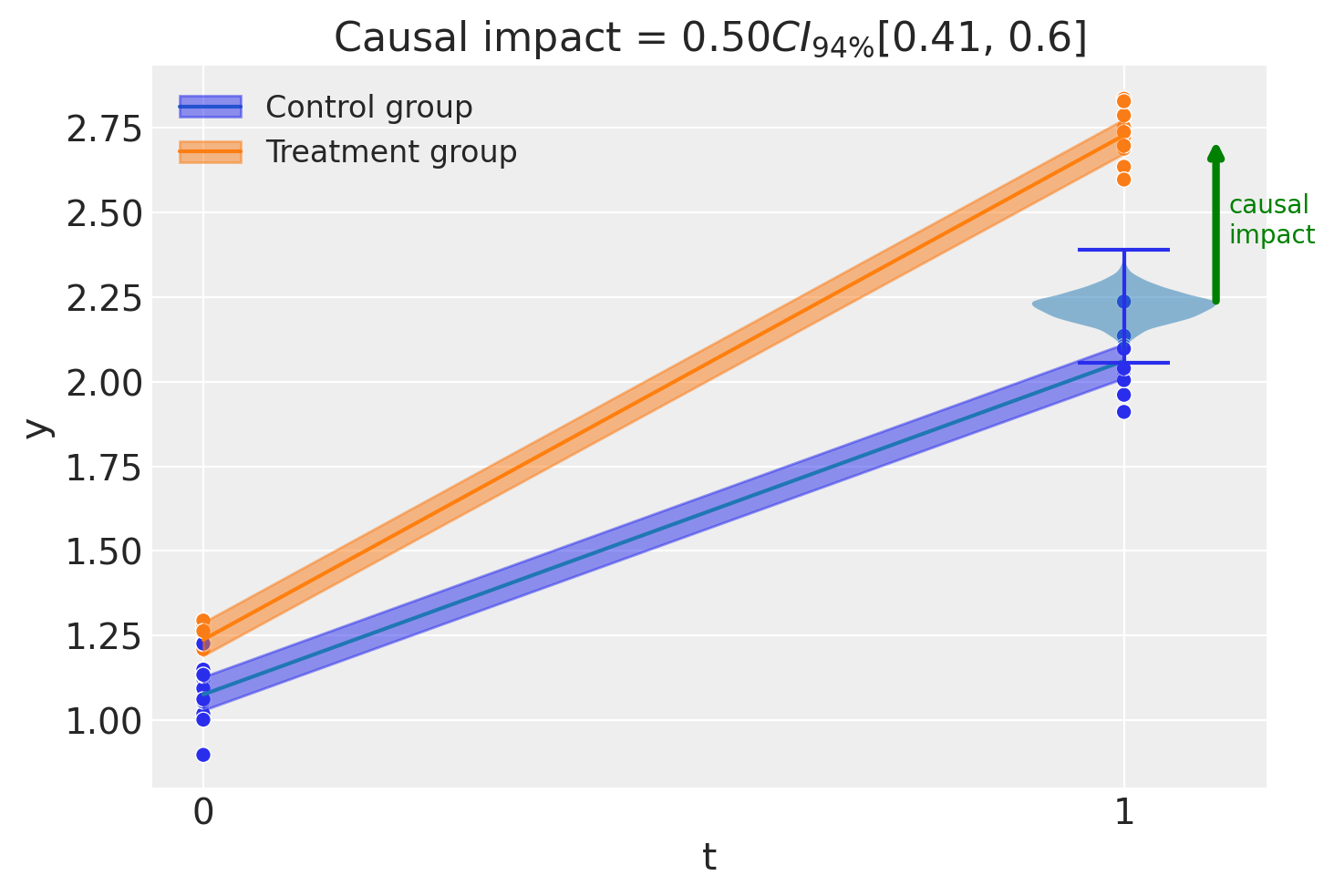
fig, ax = result.plot()
result.summary()
===========================Difference in Differences============================
Formula: y ~ 1 + group*post_treatment

Results:
Causal impact = 0.50$CI_{94\%}$[0.41, 0.6]
Model coefficients:
    Intercept                     1.1, 94% HDI [1, 1.1]
    post_treatment[T.True]        0.99, 94% HDI [0.92, 1.1]
    group                         0.16, 94% HDI [0.092, 0.23]
    group:post_treatment[T.True]  0.5, 94% HDI [0.41, 0.6]
    y_hat_sigma                   0.082, 94% HDI [0.066, 0.1]
We can get nicely formatted tables from our integration with the maketables package.
from maketables import ETable

result.set_maketables_options(hdi_prob=0.95)
ETable(result, coef_fmt="b:.3f \n [ci95l:.3f, ci95u:.3f]")
| y | |
|---|---|
| (1) | |
| coef | |
| post_treatment=True | 0.986 [0.915, 1.063] |
| group | 0.162 [0.088, 0.231] |
| group × post_treatment=True | 0.505 [0.399, 0.606] |
| Intercept | 1.075 [1.025, 1.128] |
| stats | |
| N | 40 |
| Format of coefficient cell: Coefficient [95% CI Lower, 95% CI Upper] | |
ax = az.plot_posterior(result.causal_impact, ref_val=0)
ax.set(title="Posterior estimate of causal impact");
Effect Summary Reporting#
For decision-making, you often need a concise summary of the causal effect. The effect_summary() method provides a decision-ready report with key statistics. Note that for Difference-in-Differences, the effect is a single scalar (average treatment effect), unlike time-series experiments where effects vary over time.
# Generate effect summary
stats = result.effect_summary()
stats.table
| mean | median | hdi_lower | hdi_upper | p_gt_0 | |
|---|---|---|---|---|---|
| treatment_effect | 0.504728 | 0.503797 | 0.398865 | 0.605905 | 1.0 |
print(stats.text)
The average treatment effect was 0.50 (95% HDI [0.40, 0.61]), with a posterior probability of an increase of 1.000.
You can customize the summary with different directions and ROPE thresholds:
Direction: Test for increase, decrease, or two-sided effect
Alpha: Set the HDI confidence level (default 95%)
ROPE: Specify a minimal effect size threshold
# Example: Two-sided test with ROPE
stats = result.effect_summary(
    direction="two-sided",
    alpha=0.05,
    min_effect=0.3,  # Region of Practical Equivalence
)
stats.table
| mean | median | hdi_lower | hdi_upper | p_two_sided | prob_of_effect | p_rope | |
|---|---|---|---|---|---|---|---|
| treatment_effect | 0.504728 | 0.503797 | 0.398865 | 0.605905 | 0.0 | 1.0 | 0.9995 |
print("\n" + stats.text)
The average treatment effect was 0.50 (95% HDI [0.40, 0.61]), with a posterior probability of an effect of 1.000.