

Synthetic control with scikit-learn models#
import causalpy as cp
Load data#
df = cp.load_data("sc")
treatment_time = 70
Donor pool selection#
Before fitting, it is good practice to inspect pairwise correlations among units in the pre-treatment period. Negatively correlated donors should be excluded to avoid interpolation bias [Abadie et al., 2010, Abadie, 2021].
pre = df.loc[:treatment_time]
corr, ax = cp.plot_correlations(pre, columns=["a", "b", "c", "d", "e", "f", "g"])
ax.set(title="Pre-treatment correlations")
[Text(0.5, 1.0, 'Pre-treatment correlations')]
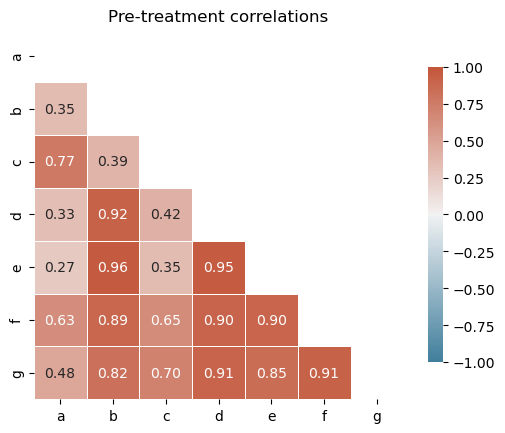
All control units are positively correlated with the treated unit (actual), so no donor pool curation is needed for this dataset. In practice, you would exclude any controls with negative or near-zero correlations.
Analyse with WeightedProportion model#
result = cp.SyntheticControl(
    df,
    treatment_time,
    control_units=["a", "b", "c", "d", "e", "f", "g"],
    treated_units=["actual"],
    model=cp.skl_models.WeightedProportion(),
)
fig, ax = result.plot(plot_predictors=True)
result.summary(round_to=3)
================================SyntheticControl================================
Control units: ['a', 'b', 'c', 'd', 'e', 'f', 'g']
Treated unit: actual
Model coefficients:
  a	     0.319
  b	    0.0597
  c	     0.294
  d	    0.0605
  e	  0.000762
  f	     0.234
  g	    0.0321
Pre-treatment correlation (actual): 0.9961
We can get nicely formatted tables from our integration with the maketables package.
from maketables import ETable

ETable(result, coef_fmt="b:.3f")
| y | |
|---|---|
| (1) | |
| coef | |
| a | 0.319 |
| b | 0.060 |
| c | 0.294 |
| d | 0.060 |
| e | 0.001 |
| f | 0.234 |
| g | 0.032 |
| stats | |
| N | 100 |
| R2 | 0.992 |
| Format of coefficient cell: Coefficient | |
Effect Summary Reporting#
For decision-making, you often need a concise summary of the causal effect. The effect_summary() method provides a decision-ready report with key statistics.
Note
OLS vs PyMC Models: When using OLS models (scikit-learn), the effect_summary() provides confidence intervals and p-values (frequentist inference), rather than the posterior distributions, HDI intervals, and tail probabilities provided by PyMC models (Bayesian inference). OLS tables include: mean, CI_lower, CI_upper, and p_value, but do not include median, tail probabilities (P(effect>0)), or ROPE probabilities.
# Generate effect summary for the full post-period
stats = result.effect_summary()
stats.table
| mean | ci_lower | ci_upper | p_value | relative_mean | relative_ci_lower | relative_ci_upper | |
|---|---|---|---|---|---|---|---|
| average | -1.757497 | -2.625051 | -0.889943 | 0.000271 | -10.132258 | -15.262594 | -5.001922 |
| cumulative | -52.724906 | -78.751527 | -26.698285 | 0.000271 | -303.967742 | -457.877825 | -150.057659 |
# View the prose summary
print(stats.text)
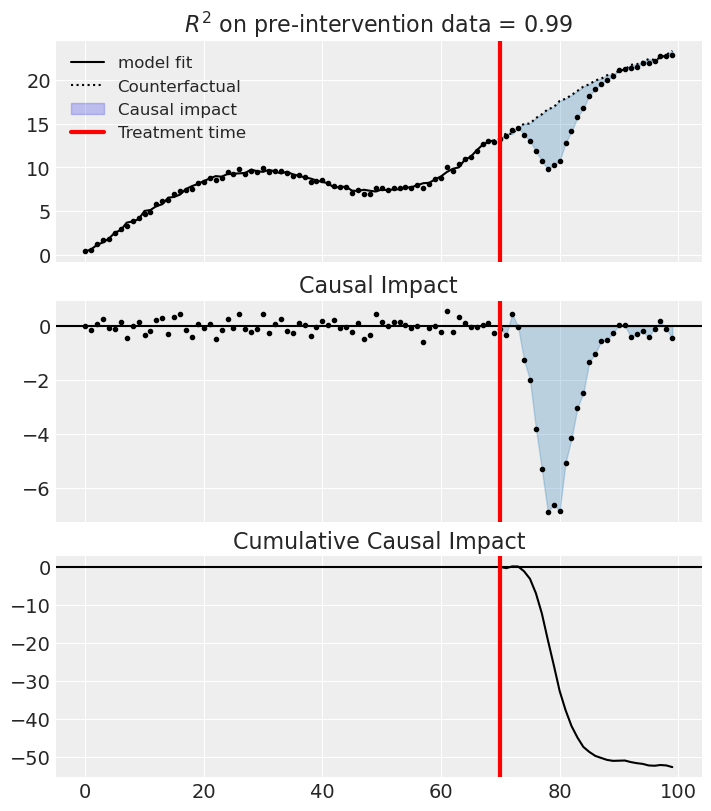
During the Post-period (70 to 99), the response variable had an average value of approx. 17.07. By contrast, in the absence of an intervention, we would have expected an average response of 18.83. The 95% confidence interval of this counterfactual prediction is [17.96, 19.70]. Subtracting this prediction from the observed response yields an estimate of the causal effect the intervention had on the response variable. This effect is -1.76 with a 95% confidence interval of [-2.63, -0.89].

Summing up the individual data points during the Post-period, the response variable had an overall value of 512.18. By contrast, had the intervention not taken place, we would have expected a sum of 564.91. The 95% confidence interval of this prediction is [538.88, 590.94].

The 95% confidence interval of the effect [-2.63, -0.89] does not include zero (p-value 0.000). Relative to the counterfactual, the effect represents a -10.13% change (95% CI [-15.26%, -5.00%]).

This analysis assumes that the control units used to construct the synthetic counterfactual were not themselves affected by the intervention, and that the pre-treatment relationship between control and treated units remains stable throughout the post-treatment period. We recommend inspecting model fit, examining pre-intervention trends, and conducting sensitivity analyses (e.g., placebo tests) to support any causal conclusions drawn from this analysis.
But we can see that (for this dataset) these estimates are quite bad. So we can lift the “sum to 1” assumption and instead use the LinearRegression model, but still constrain weights to be positive. Equally, you could experiment with the Ridge model (e.g. Ridge(positive=True, alpha=100)).
References#
Alberto Abadie, Alexis Diamond, and Jens Hainmueller. Synthetic control methods for comparative case studies: estimating the effect of california's tobacco control program. Journal of the American Statistical Association, 105(490):493–505, 2010.
Alberto Abadie. Using synthetic controls: feasibility, data requirements, and methodological aspects. Journal of Economic Literature, 59(2):391–425, 2021.